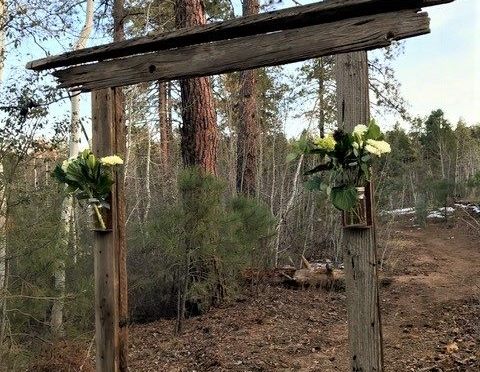
Back in December 2016 I helped a friend set up a rustic “chapel in the woods” in a stand of aspens up Copper Basin in Prescott for a vow-renewal ceremony of his parents. I built the arch out of weathered barnwood from the Colorado farm and pieces from a sluice box from a local prospecting operation from years gone by. I got latillas from a local sawmill (stripped lodgepole pines) sourced from Idaho, and made the light poles with weighted concrete bases. Mason jar vases and holders were the finishing touch.
If you are interested in renting these elements for future events, or if you’d like something similar created for your event, use the Contact link at the top of the page. I can also create other coordinating elements, such as more light poles, for rental or purchase.
Five years ago, in 2012, with the first stage of the Prescott Donut Factory under my belt (before The Warehouse expansion) I had another restaurant project come along that really shaped the way I work and gave Anastasis a lot of needed visibility. That project was Biga, a very small local eatery that quickly garnered a strong following and good buzz about town – for good reason. Original owners Annie and Kristen developed a delicious and morphing seasonal menu which was an eclectic combination of fresh/local and perfectly executed “comfort foods” from around the country.
I came up with a wall-cladding system to hide the existing drywall (without removing it) by using rib lath and veneer stone mortar, to give the impression of something like poured concrete walls, columns, and beams.
But it was my job to design and build out the dining room and bar on a shoestring budget. To be honest, I did this project more for the visibility and portfolio-building potential (and the creative freedom to pretty much have carte-blanche, floor to ceiling) than profitability. I was barely started with the business and undervalued my services severely in those days.
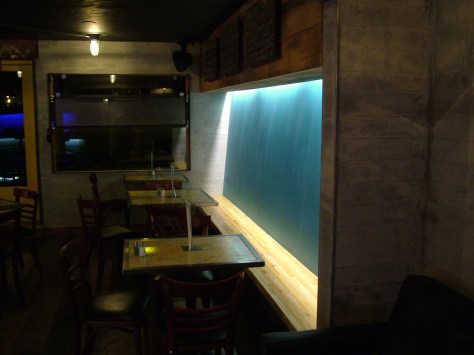
The bench seating alcove at the blue wall allows for multiple small tables to be pulled together to form a continuous table for larger parties.
So what we were able to pull off for the money was still a major achievement in my book (I was working with a friend at the time.) Biga remains open and popular today under new ownership.
Entry door.
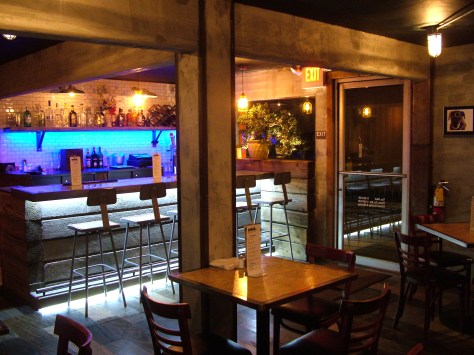
The idea was to take the existing tiny restaurant – an Italian joint whose interior sported a mess of faux-painted walls, trellis, plastic grapes, and other “Tuscan” cliches – and transform it into an urban industrial vibe, as if you had entered an underground machine-shop-turned-hip-drinking-establishment in a major city. Prescott is not a major urban center, and we just don’t have the long-established history of built environment here like you find on the East Coast. So we had to create that blend of “gritty” and fresh new intervention all from scratch.
“Before”
“Before”
“Before”
“Before”
This project was never highlighted on this site, so five years later, it’s about time to bring out these old photographs from just before it was first opened. It was an exciting time, and I’m grateful to the original owners for giving me the opportunity and trusting me to re-create the old restaurant into the unique and exciting space that Biga is known for.
Check out the full gallery below with captions that describe the design elements:
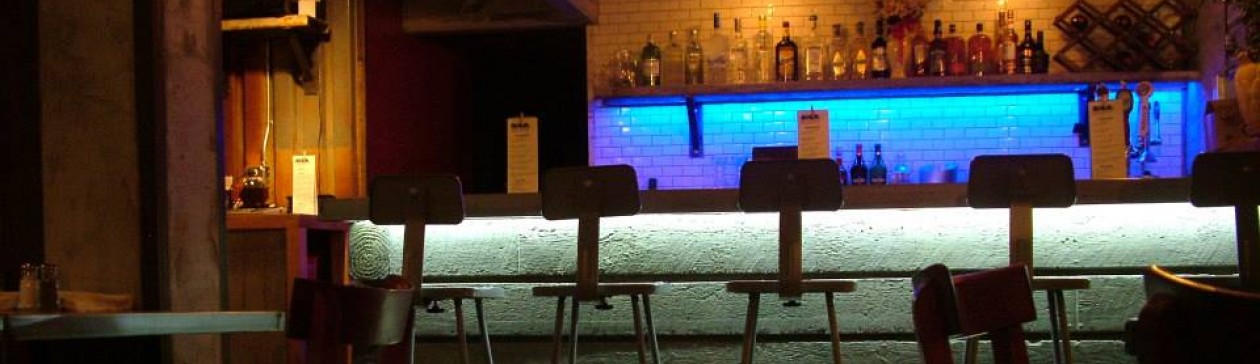
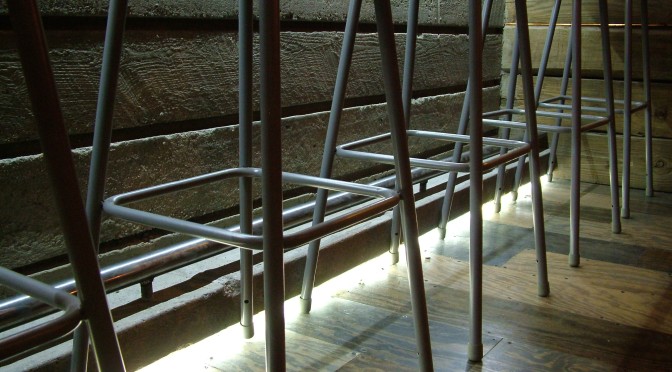
A cast-in-place concrete bar was formed with rough-sawn boards, topped with a steel-and-glass bartop and illuminated with LEDs.
This iconic blue wall defined the space, sloping slightly to serve as the back of the long bench. “Always-on” fluorescent tubes wash the wall in light, so that whether open or closed, the restaurant would always have a glow of life.
A full bar for a tiny restaurant gives patrons a broad range of drink options.
The “blue wall” had a custom paint color mixed – I call it “electric safety blue”
These mechanical steel sun shades were designed to be raised or lowered to break the powerful sun which pours through these windows in the evenings during certain times of the year.
This “butcher-block” style bench was glued up using the same stock of cedar as the form boards for the concrete bar wall.
I came up with a wall-cladding system to hide the existing drywall (without removing it) by using rib lath and veneer stone mortar, to give the impression of something like poured concrete walls, columns, and beams.
Lighting above the bar.
Colored LEDs and “farm lights” illuminate bottles and white subway tile of the back bar.
The bench seating alcove at the blue wall allows for multiple small tables to be pulled together to form a continuous table for larger parties.
The restroom hallway, with lots of heavy, rusty steel.
Industrial “safety” colors continue.
Heavy timbers “bookend” the two sides of the bar.
I love the end grain of these timbers – actually guardrail posts.
Footlighting at the bar gives the sense of the heavy concrete floating.
We made the flooring, too, making planks from thin plywood and using a mix of four different stain colors.
I made this coffee table in the waiting area, as well as all the other table tops from steel and OSB.
The back bar cabinets are laboratory cabinets. They worked great in the space.
Glass and steel bar. Lab stools. I also designed the menu stands (there are no paper menus, just a folded piece of paper clipped to a sheetmetal stand for each table.)
Legacy plant from the old restaurant.
Heavy steel bar shelf and subway tile.
Back bar. Gotta have some diamond plate.
Mortar and steel cladding on the column, and exposed-conduit lighting with “explosion-proof” fixtures.
Steel decking used in the bay window ceiling.
I even made this planter for the window with a found object “dingbat.”
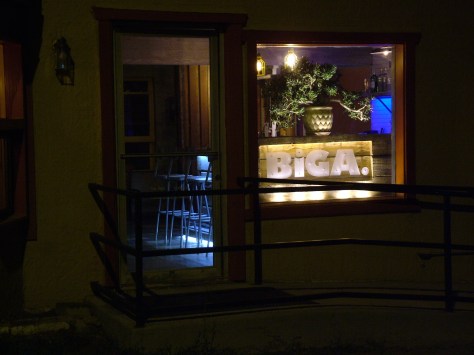
I designed the bar-end to be an illuminated acrylic sign for the window.
View from the outside. A blah exterior hides an impressive interior.
Entry door.
I had these letters laser-cut from frosted acrylic.
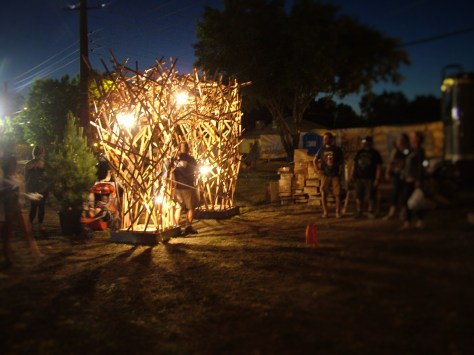
I was asked to create a gateway entry arch for a new artisan market event held in downtown Prescott this June. It was to be an eye-catching feature to welcome people in, and illuminated at night (this was coupled with a beer and food-truck event that ran till 10 pm.)
Other than that, the parameters were pretty wide open – not always a good thing, but since I was creating this as a promotional piece for Anastasis, thus self-funding it, I had to keep the costs down. Of course, I wanted to utilize reclaimed material.
The arch was created from 2×2 deck balusters from two different sources, redwood and cedar. These were ripped lengthwise to produce slender sticks, which were attached together piece by piece with pneumatic finish nails. This created a surprisingly strong yet flexible and relatively lightweight and wind-resistant structure.
The clear halogen bulbs create a projector-effect starburst of light and shadow on the ground.
The bases are reclaimed wood, weighted with regional river rock and retained at the outer perimeter with a band of light-gauge steel. Six clear halogen bulbs provide internal illumination of the wooden “exploding matchbox” structure. The interior opening is 7′ x 7′; overall height is approximately 10 feet.
The arch was constructed fully outside my shop and transported whole (with the assistance of three other strong guys) on a trailer to and from the venue.
The arch is now in my yard, waiting its next public appearance. I am very willing to rent it out and transport it to and from an event in the Prescott area. Perhaps a couple with good taste in modern art and architecture will want it for a wedding? Alternately, I am also willing to sell it outright for a more permanent feature in a yard.
I was asked to design, fabricate, and install some custom lighting for a very high-end home about to be placed on the market.
The existing light fixtures were cheap, underscaled, and not suited to the overall look and feel of this very grand entryway.
The same was true in the kitchen. Over the island were two small, cheap pendants. I made a large suspended fixture with ten individual lamps (controlled by an in-wall dimmer) from two intersecting barn beams.
This L-shaped chandelier followed the island beneath, adding needed illumination and atmosphere, and was suspended from the ceiling using real lasso rope.
The beams, like the wood for the entry sconces, were reclaimed from a Colorado farm demolition project in 2014 that just keeps on giving.
These beams were capped with copper boxes which were given an darkened patina look through the help of an oxidizer.
Yes, there is a burned-out bulb in these photos. One arrived in the mail with broken filaments – I had to take my photos before I could get the replacement!
The soft arch of the central sconce in the foyer is formed from a pair of leaf springs found at my local salvage yard.
The client had purchased this orb created from four barrel hoops from Revised in Prescott (where I sell some of my work.) I turned this into a dining room fixture with four Midwood vintage bulbs from Brooklyn Bulb Co. and brown rayon-covered cord. The suspension armature for the four bulbs was something I welded up specific for the purpose. This piece is similar to the Orb Lamps I made last year.
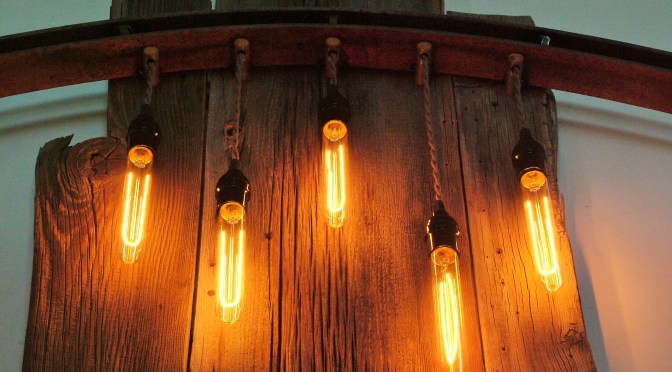
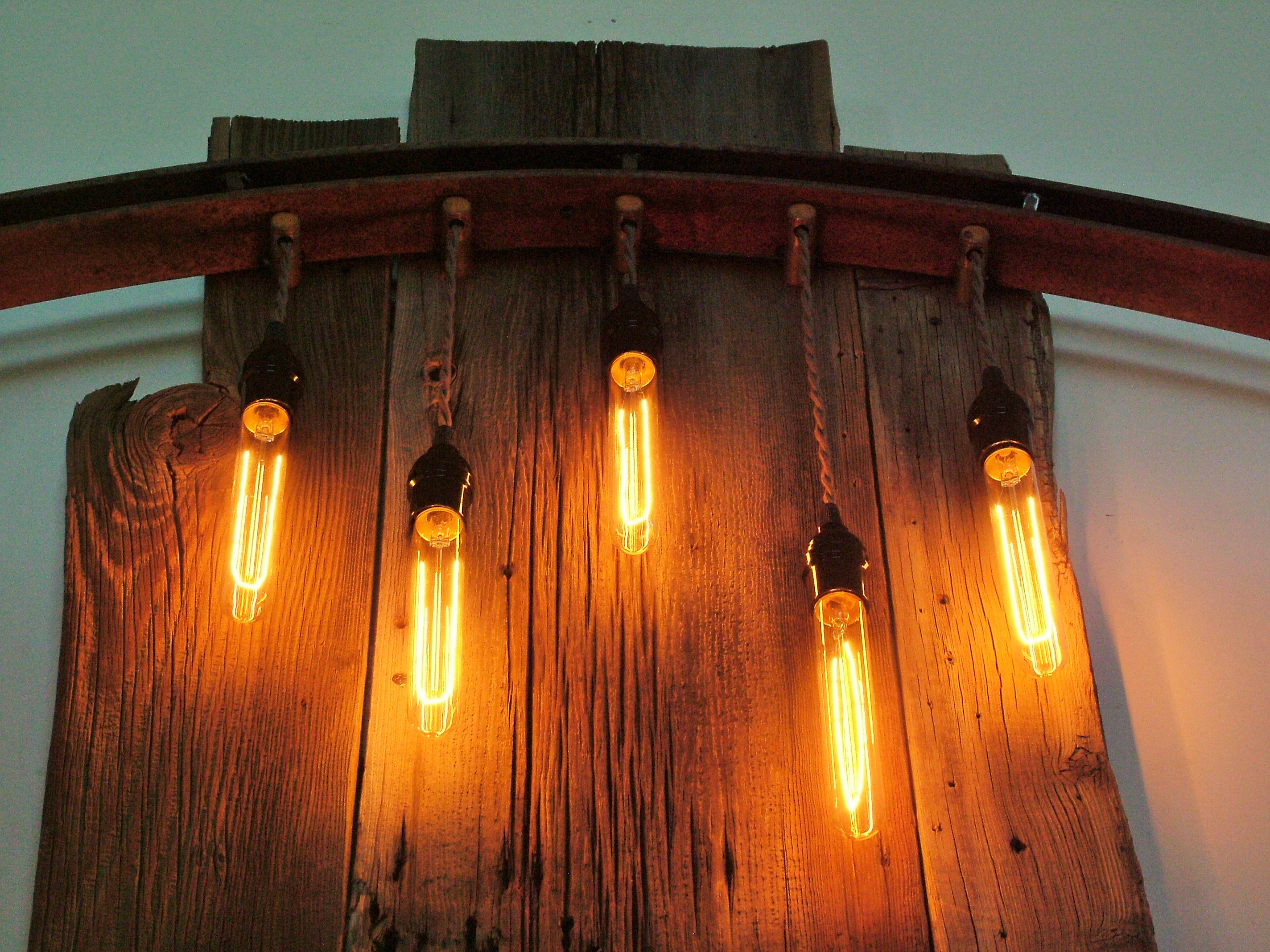
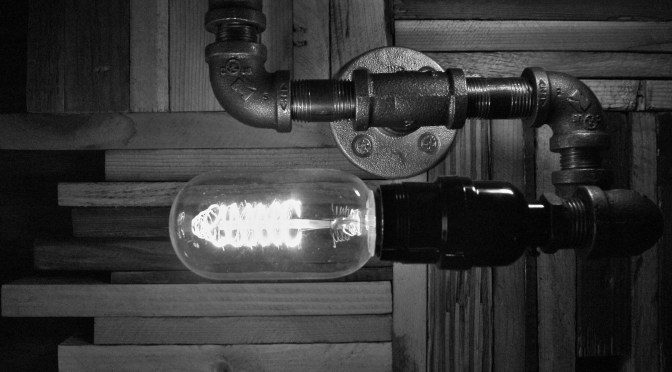
As a complement to the Stack Sconces, I created a ceiling-mounted fixture for the hallway at the Schultz house which utilizes the reclaimed wood scraps and black iron pipe, just as before. Two “radio tube” spiral filament bulbs are the finishing touch. Approx. 18 x 18″.
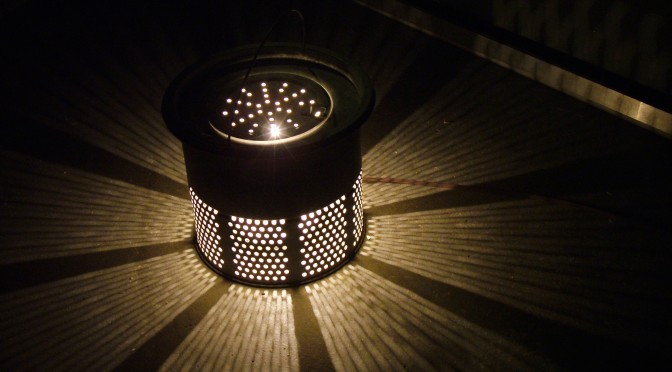
Sometimes with a little help, a simple artifact can become something extraordinary. I used to go fishing with my dad when I was a kid in Pennsylvania, and we would sometimes take a minnow bucket like this with us to keep the live bait he would catch in a local stream.
This slideshow requires JavaScript.
This first one is a Christmas gift for a faithful client, but you can bet I’ll be making more soon.
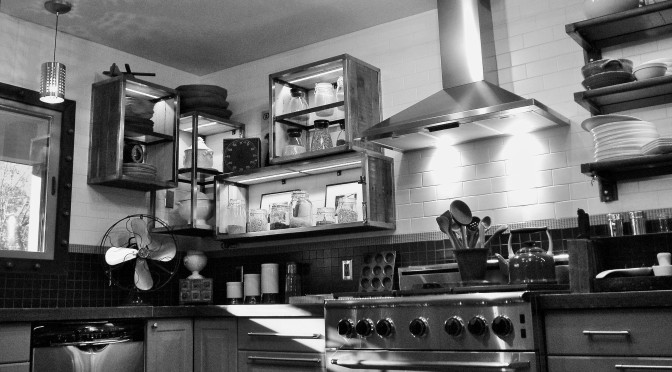
There’s a lot to see in the Schultz kitchen, since from top to bottom I designed, fabricated, and installed pretty much every detail, with the exception of appliances of course, and concrete countertops and tilework done by my good friend Ben Baker at Covenant Tile and Stone. There are the Box Shelves which got their previous feature post. But there’s enough that I would like to spread out the work over a series of posts.
For the serious foodie, you need a serious kitchen. And this one doesn’t mess around. A big Dacor commercial-style range with a stainless steel hood is prominently featured, as well as a deep single-basin sink with a tall sprayer/spigot combo faucet. Tile from the counter height up provides the backdrop for a variety of open shelving, which provides ready access to dishes, canisters, and cookware. Base cabinet system is IKEA. Industrial boiler “bulkhead-style” steel frames accent the kitchen window and a big pass-through to a small bar into the dining room. Lighting is all original design by Anastasis. Flooring throughout the kitchen and upstairs level is Cali Bamboo – beautiful and super durable.
Concrete countertop and tilework by Covenant Tile and Stone, Prescott, Arizona.
These shelves are constructed from highway signpost, salvaged steel tube, and a metal picnic table bench.
A variety of artisan oils and vinegars from Olive U in Prescott, Arizona get their dedicated shelves, constructed from steel channel.
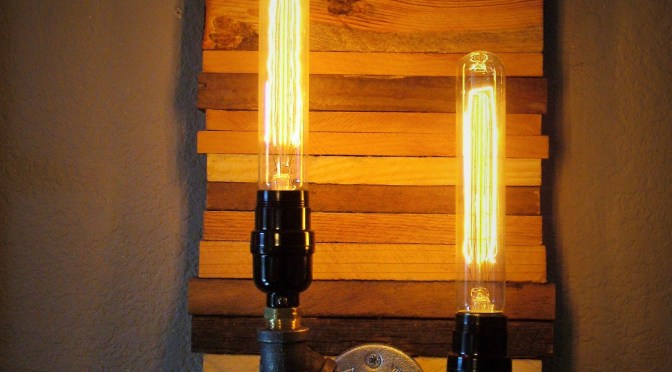
This pair of sconces in a dining room was created from leftover wood scraps and black iron pipe fittings, each with a pair of tubular low-wattage vintage bulbs. They are equipped with on/off touch controls to illuminate them with just a brush of the hand.
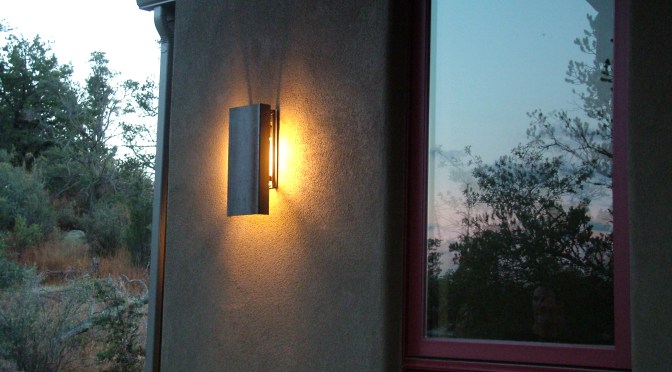
I designed and fabricated a set of wall-washing exterior sconces that use the simplicity of a length of steel C-channel combined with a single LED standard-base bulb. The low humidity of the Arizona high desert will allow the raw steel to slowly develop a patina over time at this beautiful new home in Prescott, Arizona.




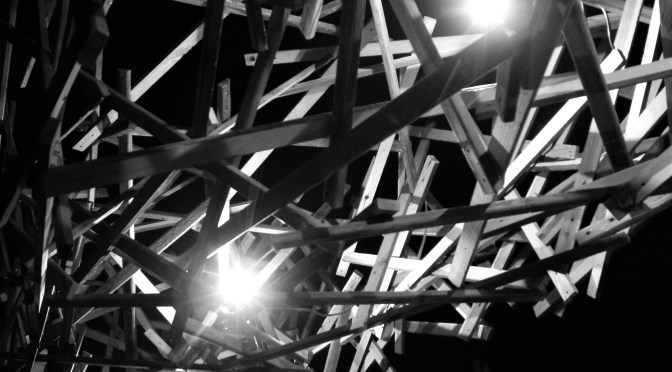
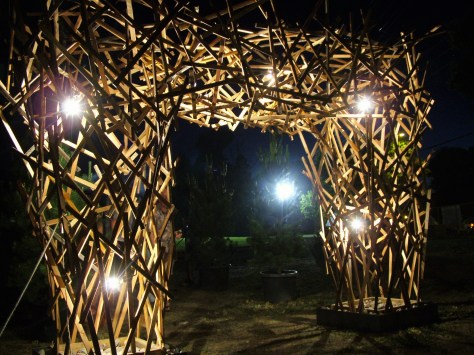 The arch was created from 2×2 deck balusters from two different sources, redwood and cedar. These were ripped lengthwise to produce slender sticks, which were attached together piece by piece with pneumatic finish nails. This created a surprisingly strong yet flexible and relatively lightweight and wind-resistant structure.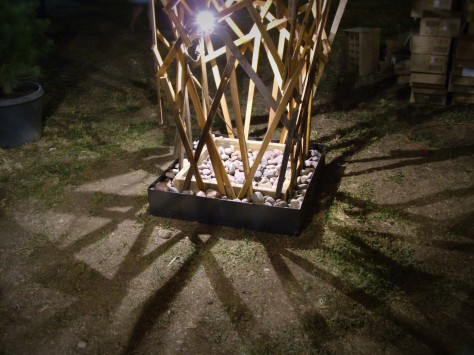








 anastasis